

High-tech Enterprise Dedicated to the Research and Development
Learn more

High-tech Enterprise Dedicated to the Research and Development
Learn more

News

Dedicated to the development and research of internet technology

Impurities in electrolyte additives Impurities in electrolyte additives
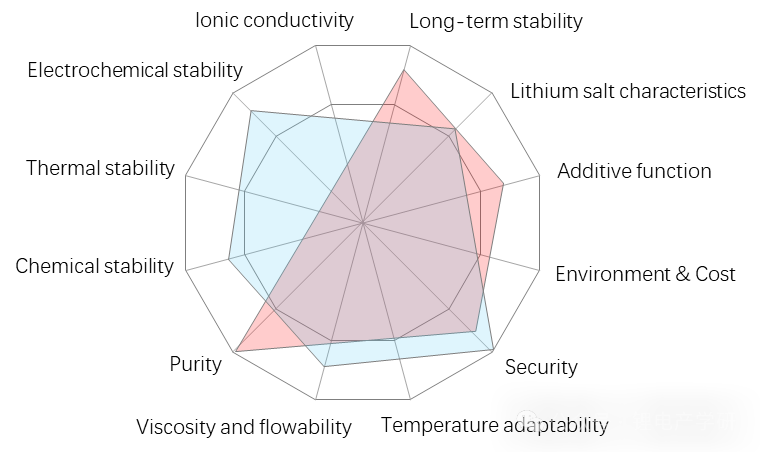
Miscellaneous impurities in electrolyte additives: 1. Impurities are unavoidable, and what impurities matter. 2. Some compatible impurities. 3. Little influence on impurities sulfate fluorion phosphate carbonate dimer or trimer residual solvent 4. Very large impurities chloride ions: water alcohols, aldehydes, acids, substances containing active hydrogen impurities Metal ions: environmental pollutants: 5. The impact is not clear. First of all, whether it is a benign influence or a small influence, it is not "do not control". All impurities need to be regulated, at least to know how much their content is, at least how much is allowed to depend on their nature.
New electrolyte additive helps stabilize cycling of 5V lithium metal batteries (EES) New electrolyte additive helps stabilize cycling of 5V lithium metal batteries (EES)
In recent years, based on cobalt-free LiNi0.5Mn1.5O4 (LNMO) positive electrode (5 V class, vs. Li+/Li) and lithium metal anode (3.04 V vs. Ultrahigh pressure lithium metal batteries with standard hydrogen electrodes have attracted a lot of attention as promising candidates for the next generation of high energy density and sustainable batteries due to their theoretical energy density of up to ~650 Wh/kg. In contrast to the unstable layered oxide LiNixCoyMnzO2, the toxic Co element caused by the LNMO spinel structure is eliminated and the inherent safety is eliminated. However, their development is severely limited by the incompatibility between the state-of-the-art carbonate electrolyte and the two aggressive electrodes. Here, we have synthesized a new electrolyte additive,2, 2-difluoroethylmethyl sulfone (FS), which enables stable cycling of ultra-high pressure lithium metal batteries in conventional carbonate electrolytes. On the cathode side, unlike conventional electrolyte additives, FS can be selectively adsorbed on the LNMO surface to form a special assembled FS "buffer" layer that can effectively remove free carbonate molecules from the cathode surface. Therefore, during charging, the -CF2H group of FS is well decomposed by the anode to form an inorganic rich CEI, which effectively inhibits the micro-fracture and transition metal dissolution of LNMO. On the anode side, FS can also perform cathode decomposition well, resulting in an inorganic rich SEI for stable cycling of Li metal anodes. As a result, the carbonate electrolyte containing FS additives gives cobalt-free 5V-class lithium metal batteries unprecedented high performance, i.e. a 40um-Li /LNMO (load = 7 mg·cm2) full battery with a high capacity retention rate of 84% for 600 cycles at 1C using a commercial carbon-based low-concentration electrolyte. A complete battery consisting of a highly loaded cathode (20 mg·cm2) and an ultra-thin lithium anode (40 mm) has a capacity retention rate of 99% after 100 cycles at 0.25C. In addition, to our knowledge, previously unreported Li/LNMO bag-like batteries have been assembled and can run stably for more than 150 cycles. This paper is based on Rational molecular design of electrolyte additive endows stable cycling performance of cobalt-free 5 V-class lithium metal batteries, published in Energy & Environmental Science.
Why Does LiCoO₂ Die on the First 5V Charge? Scientists Took an Atomic ID Photo and Uncovered the Shocking Truth Why Does LiCoO₂ Die on the First 5V Charge? Scientists Took an Atomic ID Photo and Uncovered the Shocking Truth
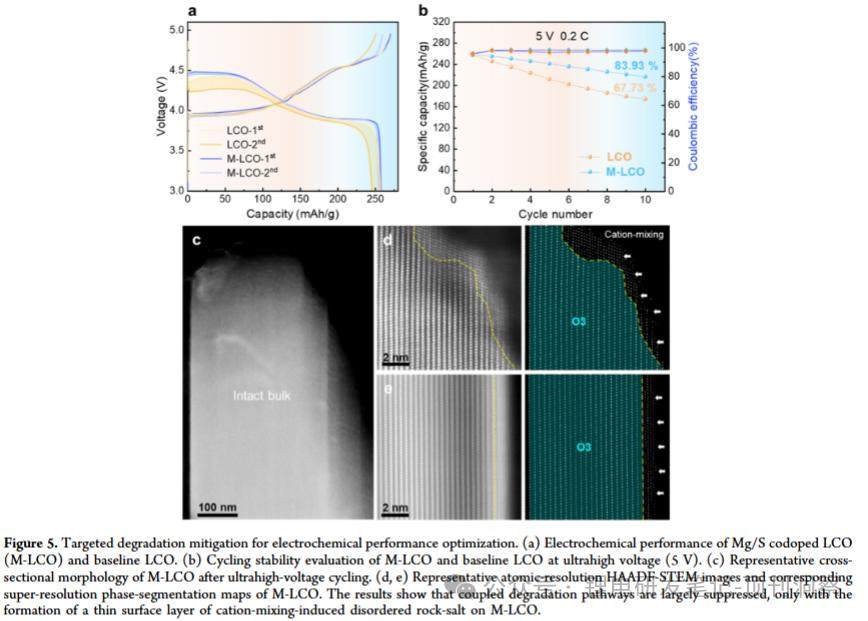
A JACS study reveals that charging LiCoO₂ to 5 V causes irreversible structural failure from the very first cycle, where deep delithiation triggers coupled in-plane shear (shattering the O3 lattice into O1/O3r mosaic domains) and out-of-plane distortion (bending, kinking, and intra-granular cracking), all kinetically trapped and accounting for a 4.3% first-cycle capacity loss. Using machine-learning-assisted super-resolution electron microscopy, the team directly visualized this chemo-mechanical degradation and proposed an Mg/S co-doping strategy—Mg pillars the layered framework while S stabilizes near-surface oxygen—which suppresses mosaic-phase formation and intra-granular cracking, boosting 10-cycle capacity retention from 67.73% to 83.93% and proving that 5 V LCO failure is deformation-dominated rather than merely surface reconstruction.
The Two-Way Relationship Between AI and Batteries Goes Far Deeper Than Power Supply The Two-Way Relationship Between AI and Batteries Goes Far Deeper Than Power Supply
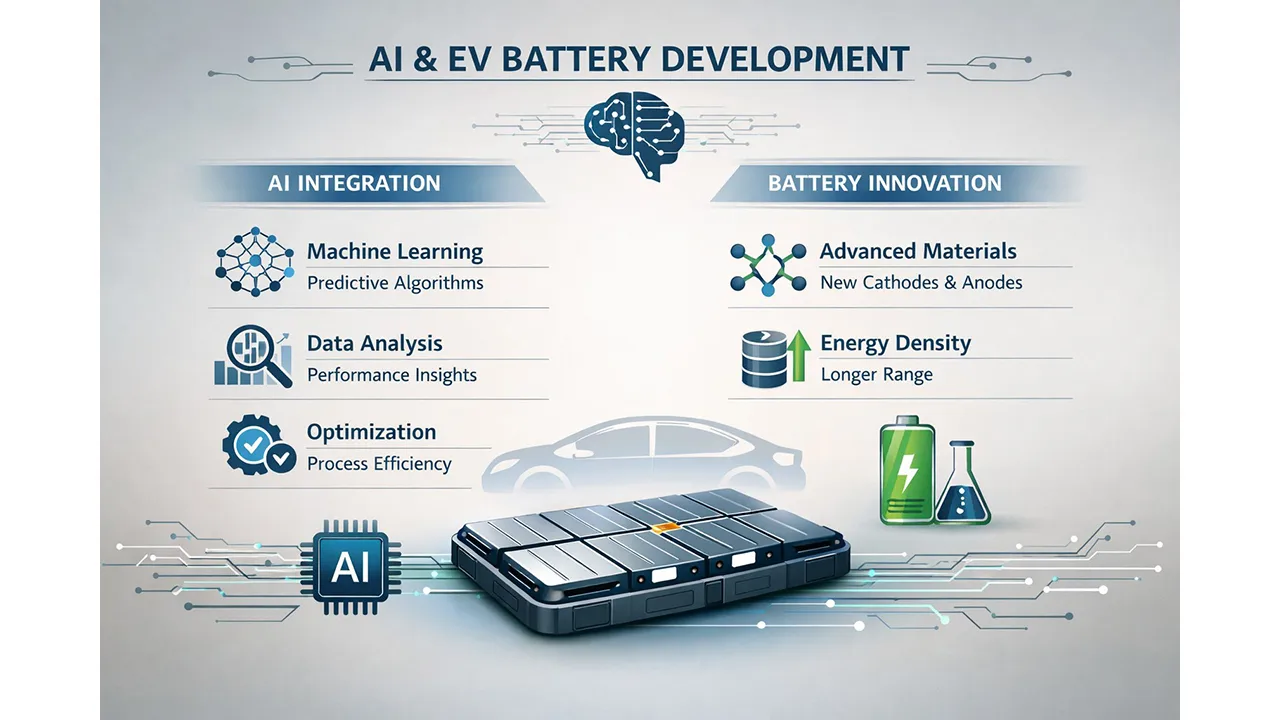
The relationship between AI and lithium batteries runs far deeper than mere power supply: batteries provide AI with the critical last line of defense that keeps computing power online, as surging GPU cabinet power from 10–40 kW in the A100 era to over 600 kW in the Rubin Ultra era forces mandatory adoption of rack-level Battery Backup Units (BBU) using full-tab small cylindrical cells that deliver 3–10C high-rate discharge, 800V compatibility, and zero fire risk, with global BBU cell demand projected to explode from 400 million units in 2026 to 2.8 billion by 2030, creating a ¥100 billion market currently dominated by Japanese and Korean players; meanwhile, AI reshapes the battery industry on both demand and supply sides — on demand, it opens high-margin scenarios like BBU, drones, and robots where per-cell profit exceeds traditional power tool cells by over tenfold, and on supply, AI vision, intelligent scheduling, digital twins, and predictive maintenance break the impossible triangle of quality, efficiency, and cost in TWh-scale manufacturing, achieving 0% defect miss rates, 5–10% capacity gains, and 20% reduction in unplanned downtime, forming a virtuous cycle where AI computing demands specialized batteries and battery mass production demands AI.
Real-time monitoring technology for LiPF₆ and LiFSI processes – tackling the pain points of core lithium-salt production in lithium batteries Real-time monitoring technology for LiPF₆ and LiFSI processes – tackling the pain points of core lithium-salt production in lithium batteries

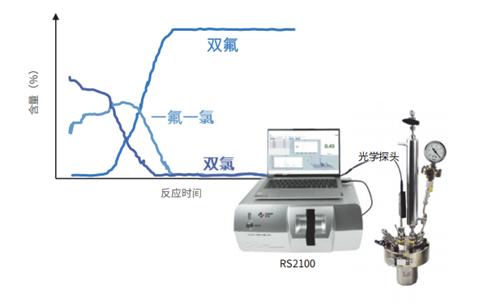
This article presents a real‑time monitoring solutions for the production of core lithium‑battery salts—LiPF₆ and LiFSI. Traditional production suffers from a “process black box” due to extreme conditions (high temperature, high pressure, strong corrosion) and hazardous gases (PF₅, HCl, HF), making reaction endpoint determination and quality control difficult. To address this, Jianzhi developed the RS2610PAT PF₅ gas online analyzer for LiPF₆ synthesis, enabling continuous, flange‑connected monitoring of exhaust gas components to precisely control PF₅ consumption, reduce waste, and cut costs—with a payback period of just 3–6 months. For LiFSI, the RS2100 series online Raman analyzer uses an immersion probe that withstands 200 °C and 15 MPa, coupled with AI‑powered spectral interpretation to track reactants, intermediates, and products in real time, cutting process R&D time by at least 75%. Already deployed in multiple mass‑production facilities, the system supports both continuous and batch lines, boosting overall production efficiency by more than 1.5×. Beyond lithium fluorinated salts, the technology also serves high‑risk reactions (nitration, hydrogenation) and biopharmaceutical processes. The article underscores how Jianzhi’s hard‑core spectroscopy technology is breaking through the “invisible, inaccurate, uncontrollable” bottlenecks in China’s new‑energy supply chain.
Electrolyte Industry Reshuffling: Order Restructuring Reshapes the Landscape, New Technologies Usher in a New Cycle Electrolyte Industry Reshuffling: Order Restructuring Reshapes the Landscape, New Technologies Usher in a New Cycle
This article analyzes the sweeping restructuring of China’s lithium‑battery electrolyte industry in 2026, driven by three concurrent forces: massive long‑term supply agreements that are redrawing the competitive map, structural overcapacity that is accelerating the exit of weaker players, and the rise of next‑generation battery technologies. CATL’s shift from Tinci to Yongtai and Capchem signals the end of a single‑leader era and the beginning of multi‑polar competition. Meanwhile, overcapacity exceeding 5.3 million tonnes is forcing market consolidation, with top players expanding while smaller firms disappear. Importantly, solid‑state and sodium‑ion batteries are not threats but new growth avenues—semi‑solid still uses electrolyte, and sodium‑ion is already scaling up. The industry is moving from crude expansion to refined, high‑end, and global competition, where innovation and customisation matter more than sheer capacity.

Online service

  Telephone:400-888-8888

 Mail:jackyang@senyangenergy.com

 Wechat:xiaoyang_1982